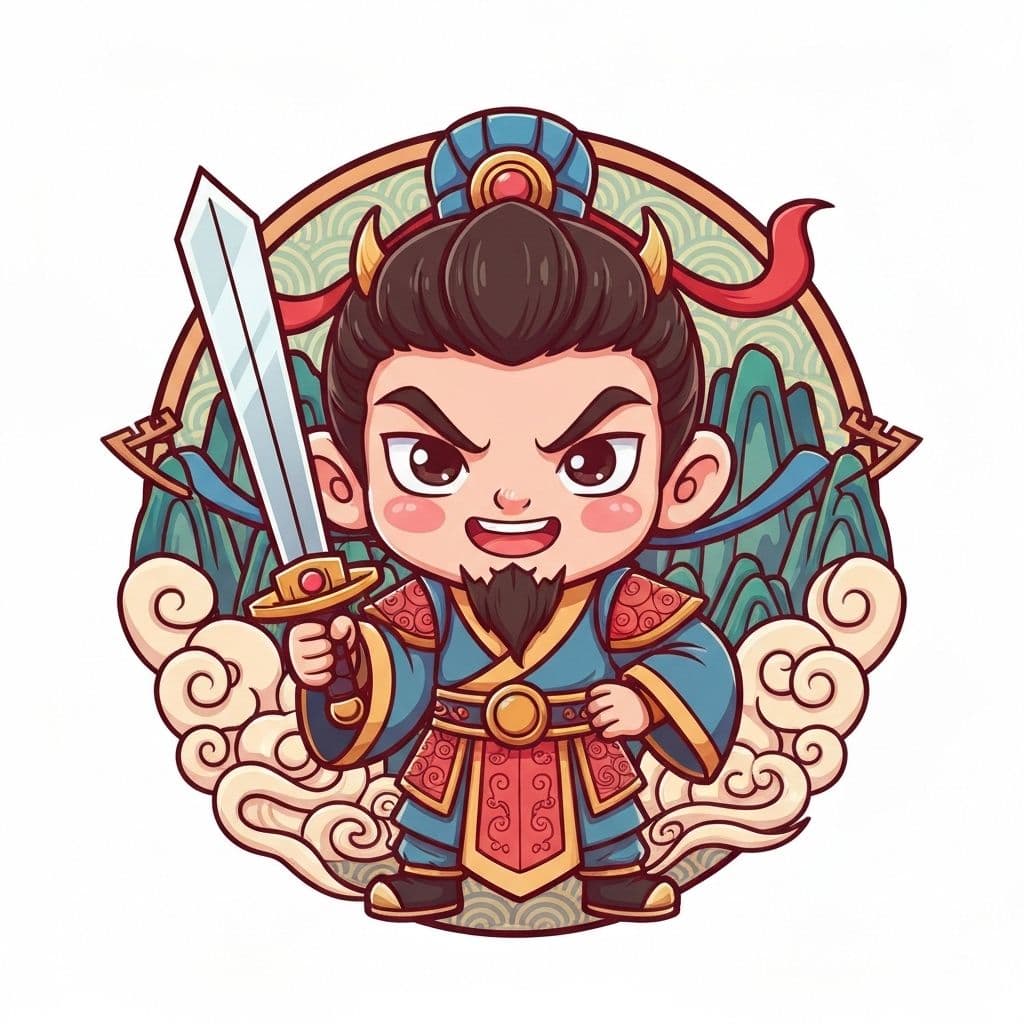
A Complete Guide to Chinese Gods and Deities
Chinese gods are among the most numerous and varied divine beings in world mythology. Where the Greek pantheon settles into roughly twelve Olympians, the Chinese pantheon never had a fixed roster: it grew over more than three thousand years, absorbing tribal ancestor worship, imperial state ritual, Taoist cosmology, Buddhist scripture and village storytelling. Hundreds of major Chinese deities appear across the classical sources, and thousands of local ones beyond them — a mountain, a river, a city gate or a kitchen stove could each have its own resident god.
What makes ancient Chinese mythology distinctive is that it was never compiled into a single scripture. The stories survive scattered across the Classic of Mountains and Seas (山海经), the Investiture of the Gods (封神演义), Journey to the West (西游记), dynastic histories, temple inscriptions and oral folk tales. The same god may be a remote cosmic force in one text and a comic, thoroughly human character in another — a flexibility that kept these figures alive rather than freezing them into doctrine.
Three traditions feed the pantheon. Taoist gods form its bureaucratic backbone, headed by the Jade Emperor and the Three Pure Ones. Buddhist deities in China — most famously Guan Yin — arrived along the Silk Road and were gradually reimagined in Chinese form. Folk religion supplies the rest: deified generals, virtuous officials, sea goddesses and door guardians raised to divinity by popular devotion. Rather than competing, these layers merged, which is why one temple courtyard can hold a Taoist immortal, a Buddhist bodhisattva and a local hero side by side.
The Celestial Hierarchy: How Chinese Gods Are Organized
The single most important thing to understand about Chinese gods is that Heaven is a government. The Heavenly Court (天庭) was imagined as a mirror of the imperial court on earth, complete with ranks, ministries, promotions, paperwork, jurisdictional disputes and the occasional corrupt official. A deity does not simply possess power — a deity holds a post, granted by decree and revocable by the same authority.
The Jade Emperor 玉皇大帝
Supreme sovereign of Heaven, Earth and the underworld. He rules by edict and appointment, delegating almost everything — the celestial equivalent of an emperor rather than a storm god.
Ministries & Bureaus 天曹诸司
Departments of Thunder, Water, Fire, Medicine, Wealth and Literature, each headed by a ranking deity with staff, records and quotas. Rain does not simply fall; it is requisitioned, approved and logged.
Marshals & Generals 天将神兵
Heaven's standing army — figures such as Nezha and Erlang Shen — dispatched to subdue demons, rebellious spirits and the occasional unruly monkey. Rank can be earned, lost or restored.
Local & Household Gods 土地灶君
City gods, earth gods, door gods and the Kitchen God who reports on each family every New Year. The lowest tier is also the closest, and by far the most frequently worshipped.
Set this against Western mythology and the contrast is sharp. The Olympians are essentially an extended family with overlapping domains and no chain of command: Zeus may be king, but Poseidon and Hades are his peers, and disputes are settled by temper rather than protocol. The Chinese pantheon is vertical instead of flat. A god of thunder reports to the Ministry of Thunder, which reports upward; a local earth god has a defined territory and can be petitioned like a magistrate. Mortals could even file complaints against negligent gods, and emperors periodically demoted deities whose temples had failed to deliver rain.
Layered on top of this structure is the syncretism of the Three Teachings (三教): Taoism, Buddhism and folk religion. Taoism supplied the bureaucratic cosmology and the ideal of the cultivated immortal. Buddhism contributed karma, rebirth, bodhisattvas and a systematic underworld. Folk religion continually promoted local heroes into the official ranks — a process the imperial state formally endorsed by granting titles to popular deities. Because none of the three ever won exclusive authority, worshippers rarely felt obliged to choose. Burning incense to a Buddhist bodhisattva, a Taoist immortal and a deified general on the same afternoon has always been entirely ordinary.
Types of Chinese Gods and Deities
Chinese deities are best approached by function rather than by family tree. The five groupings below cover almost every god you are likely to meet in literature, temple art or modern retellings — from the cosmic architects of the universe down to the guardians standing watch at a household door.
Heavenly Gods
天界神The highest tier governs the cosmos itself. The Jade Emperor presides over the Heavenly Court, while the Queen Mother of the West (西王母) tends the peaches of immortality in her Kunlun garden and decides who joins the ranks of the immortals. Standing before them both are the primordial creators — the goddess who patched a broken sky and the sage who gave humanity writing, fire and divination.
Nature Deities
自然神Before gods governed morality, they governed weather. The four Dragon Kings (龙王) rule the seas and deliver rain, which made them the deities farmers prayed to and cursed in equal measure. Lei Gong the Thunder God (雷公) and his wife Dianmu the Lightning Mother strike down the wicked, while the sun and moon carry legends of their own.
War Gods
战神Chinese war gods are commanders rather than berserkers — most hold formal celestial rank and answer to the throne. Nezha, the lotus-born boy marshal, and Erlang Shen, the three-eyed general, lead Heaven's armies against demons and rebels. Guan Yu is the clearest case of a mortal promoted to godhood: a Han general worshipped for eighteen centuries as the God of War.
Protection Deities
护佑神These are the gods people actually pray to day by day. Guan Yin, the bodhisattva of compassion, hears the cries of the suffering and is the most widely venerated deity in East Asia. Mazu (妈祖) guards fishermen across the South China Sea, door gods pasted on New Year gateways turn away misfortune, and Caishen is invited in to bring the year its prosperity.
Underworld Deities
冥界神The Chinese afterlife is administered, not merely endured. Yan Luo Wang presides over the ten courts of Diyu, reading each soul's ledger of deeds before assigning punishment or rebirth. His officers include Black and White Impermanence (黑白无常), who escort the newly dead, and Ox-Head and Horse-Face, who patrol the border between the worlds.
Most Famous Chinese Gods You Should Know
If you are meeting the Chinese pantheon for the first time, start with these six. Between them they cover the highest throne in Heaven, the gentlest act of mercy, the loudest rebellion, and the loneliest exile in Chinese mythology.
Jade Emperor 玉皇大帝
Ruler of the Heavenly Court
The supreme sovereign of the Taoist pantheon reached his throne not by birth but by cultivating virtue across uncountable eons. He governs through an immense civil service, issuing decrees rather than hurling thunderbolts — which is why he so often appears in stories as the exasperated administrator whose court is thrown into chaos by a single monkey.
See the Heavenly Court →Guan Yin 观音
Bodhisattva of Compassion
Originally the Indian bodhisattva Avalokiteśvara, Guan Yin crossed the Silk Road and was gradually reimagined in China as a merciful female figure holding a willow branch and vase of pure water. She vowed to postpone her own buddhahood until every suffering being is freed, and remains the most widely worshipped deity in East Asia.
Learn more →Sun Wukong 孙悟空
The Monkey King
Born from stone, self-taught in the seventy-two transformations, and bold enough to erase his own name from the registry of death, Sun Wukong stormed Heaven itself before being pinned beneath a mountain for five centuries. His journey from rebel to guardian makes him the most globally recognised figure in Chinese mythology.
Learn more →Nezha 哪吒
The Lotus-Born Boy Marshal
A divine pearl reborn as a general’s son, Nezha killed a dragon prince as a child, gave up his own body to spare his family, and was rebuilt from lotus root by his master. Armed with the Universe Ring and Red Armillary Sash, he embodies defiance of fate — the theme that made his story modern cinema’s favourite myth.
Learn more →Erlang Shen 二郎神
The Three-Eyed Warrior God
Nephew of the Jade Emperor and the only celestial general to fight Sun Wukong to a standstill, Erlang Shen sees through every disguise with the vertical third eye on his forehead. He carries a three-pointed double-edged spear and hunts with a loyal celestial hound, guarding both the rivers of Sichuan and the boundaries of Heaven.
Learn more →Chang'e 嫦娥
Goddess of the Moon
Wife of the archer Hou Yi, she swallowed the elixir of immortality and drifted up to the moon, where she has lived ever since with only a jade rabbit for company. Every Mid-Autumn Festival, families still raise mooncakes toward her — the tenderest and most melancholy story in the Chinese pantheon.
Learn more →Chinese Gods in Modern Culture and Entertainment
These deities are not museum pieces. In 2024, Black Myth: Wukong sold more than twenty million copies and sent players worldwide searching for who the Monkey King actually was. The animated Ne Zha (2019) and its sequel Ne Zha 2 (2025) broke box-office records in China by reframing a Ming-dynasty tale of a boy who defies his own destiny, while New Gods: Yang Jian gave Erlang Shen a jazz-age noir makeover and the ongoing Creation of the Gods films are adapting the entire Investiture war for the screen.
The influence runs far wider than any single hit. Sun Wukong is the acknowledged ancestor of Dragon Ball's Son Goku and appears as a playable character in games from Smite to League of Legends. The White Snake legend has been remade for animation and television dozens of times. Guan Yu is a fixture of Dynasty Warriors. Chinese gods have become a shared visual vocabulary for animators, game designers and novelists across Asia and increasingly beyond it.
What is striking is the continuity. The Ming novelists who wrote Journey to the West were themselves remixing centuries of older oral tales, just as today's studios remix them again. Each generation keeps the essential shape — the rebel monkey, the boy who refuses his fate, the goddess who will not abandon the suffering — and re-cuts the surface to fit its own anxieties. That is precisely how a living mythology behaves.
Frequently Asked Questions About Chinese Gods
Who is the most powerful Chinese god?
+
It depends on whether you mean authority or raw power. In terms of rank the Jade Emperor is supreme, governing Heaven, Earth and the underworld. In Taoist cosmology, however, the Three Pure Ones (三清) stand above him as embodiments of the Tao itself, and later texts place the primordial Hongjun higher still. In popular imagination the answer is often Sun Wukong, who fought Heaven to a draw despite holding no real rank at all.
How many gods are there in Chinese mythology?
+
There is no fixed number, and that is the point. Roughly two hundred deities appear consistently across major texts, but Chinese folk religion recognises thousands more: every city, mountain, river, well and kitchen stove could host its own god, and new deities were still being canonised in the Qing dynasty. Unlike a closed pantheon such as the Olympians, the Chinese pantheon has always been open to additions.
What is the difference between Chinese gods and immortals?
+
Gods (神, shen) hold office. They are appointed to a post in the celestial bureaucracy, receive offerings, and can be promoted or demoted. Immortals (仙, xian) achieve deathlessness through personal cultivation — alchemy, meditation, breathing arts or eating an elixir — and answer to no one. An immortal may be recruited into divine office, and a god may be stripped of rank, so the two categories overlap constantly.
Are Chinese gods based on real people?
+
Many are. Guan Yu was a Han dynasty general who died in 220 CE and was elevated over centuries from marquis to king to emperor to god. Mazu began as a Fujianese girl named Lin Moniang who reportedly died rescuing sailors. Caishen is identified with the warrior Zhao Gongming. This process of deifying exemplary humans, known as apotheosis, is one of the defining features of Chinese religion.
Do people still worship Chinese gods today?
+
Very much so. Tens of thousands of temples remain active across mainland China, Taiwan, Hong Kong, Singapore and Chinese communities worldwide. The annual Mazu pilgrimage in Taiwan draws millions of participants, Guan Yu shrines stand in police stations and shopfronts alike, and hundreds of millions of households still honour the Kitchen God and the God of Wealth during Lunar New Year.